5,000 USDT in the account, 3× leverage. Why is the order only 750 USDT?

RISK MANAGEMENT
The sizing formula determines notional exposure; exchange leverage affects margin requirements. Follow a 750 USDT position and 250 USDT basic margin example.
Your account holds 5,000 USDT and leverage is set to 3×, yet the order is only 750 USDT. Start with two calculations: the strategy's position sizing formula determines order notional, while exchange leverage affects initial margin. Mixing those numbers hides how much exposure is actually in the market.
A position percentage needs a defined base. Notional exposure measures the amount participating in price changes; initial margin measures the basic collateral required to open it. When checking an AlgoRover order, list account equity, available balance, the sizing formula and exposure limits together.
What does the strategy multiply by its 5% sizing setting?
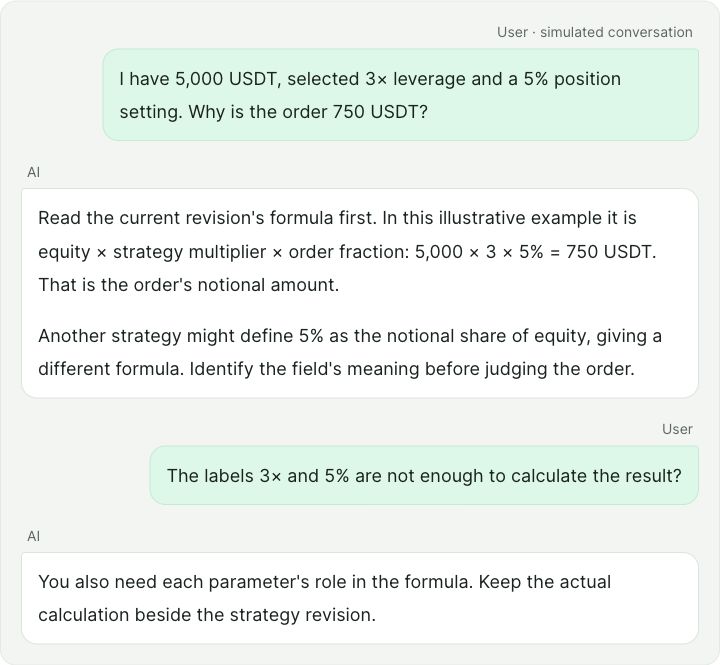
Check the formula before judging the order size
A position percentage can refer to equity, margin or available funds. Ask which account field supplies each input and which revision uses it.
Why can 750 USDT of exposure use 250 USDT of basic margin?
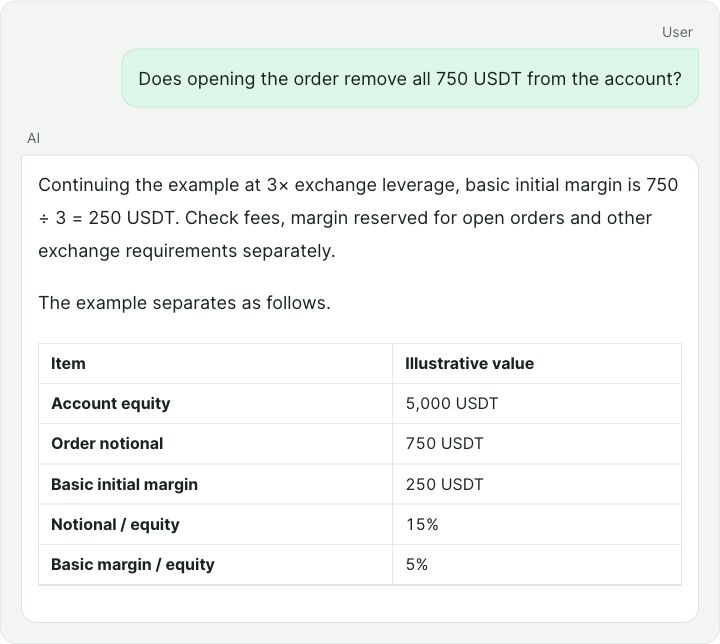
Collateral and market exposure answer different questions
750 USDT describes the position's sensitivity to price changes. 250 USDT is its basic margin in this example. Also account for other positions and orders when checking available funds.
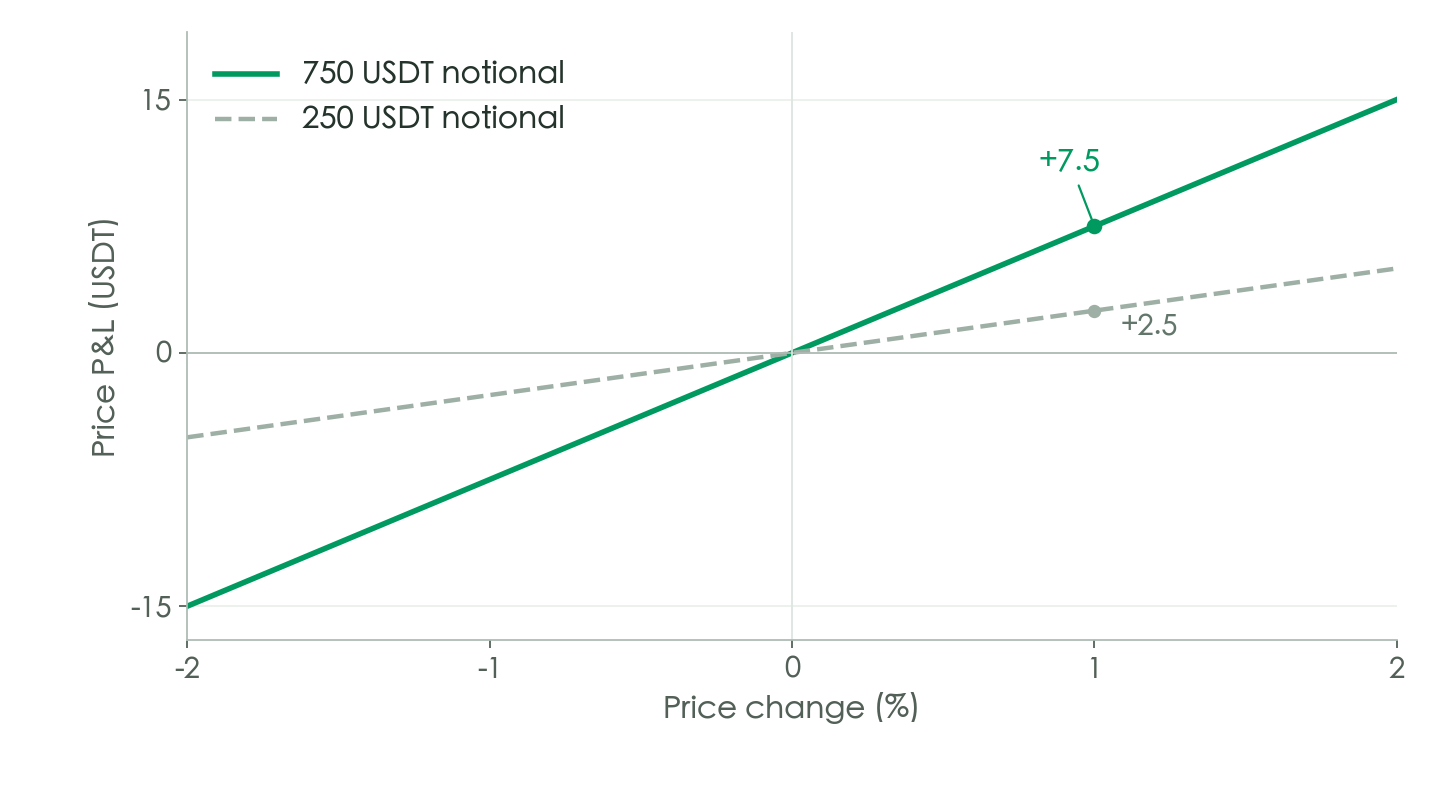
Illustrative example: a 1% price rise produces 7.5 USDT on 750 USDT notional, three times the 2.5 USDT on 250 USDT notional.
Does raising exchange leverage automatically increase the position?
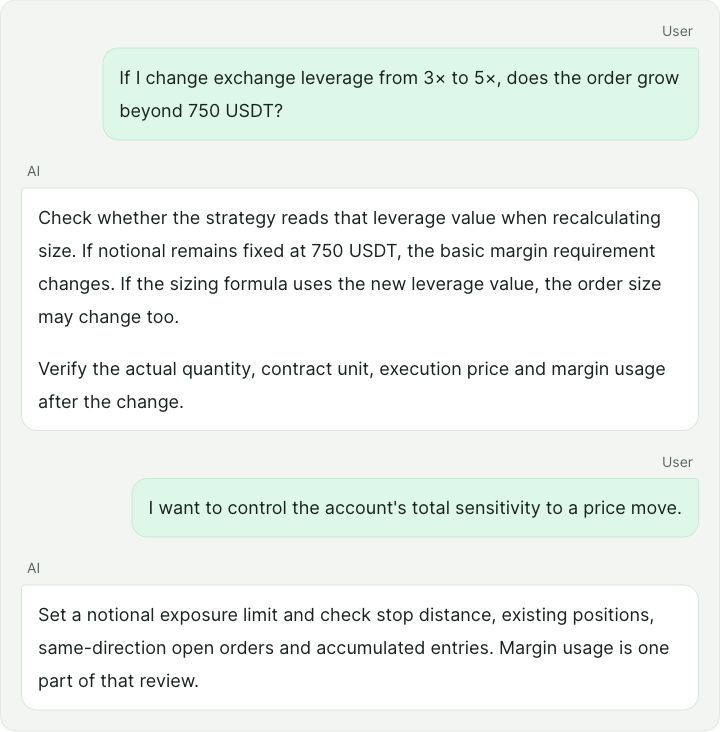
Express the exposure limit as a checkable amount
Record single-order notional as a share of equity, total same-direction exposure and the price move's P&L effect. These are more concrete than calling a position small.
Ask AI to trace order size, margin and total exposure
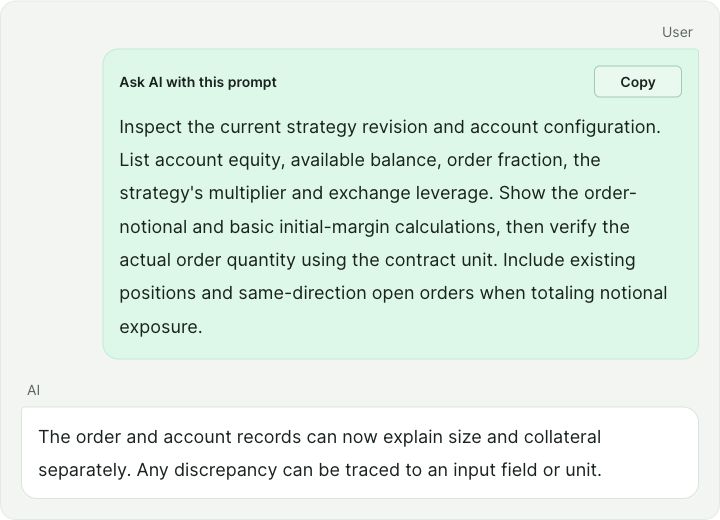
Keep one complete calculation
Repeat the same calculation after changing the strategy, contract or exchange. Each parameter change then has a clear numerical target.
Position sizing and leverage: common questions
What is the difference between position percentage and margin percentage?
A position percentage may refer to notional exposure, equity allocation or an order budget, depending on the strategy. Margin percentage describes collateral usage. Check the field definition and exchange leverage separately.
Should position sizing use equity or available balance?
Use the base defined in the current strategy. Equity measures overall account value; available balance also reflects reservations for positions, orders and costs. Verify the actual field read by the formula.
Why doesn't 3× leverage put the entire account into the trade?
Exchange leverage affects margin requirements. The strategy's order fraction, capital base, existing positions and exposure limits also determine trade size. Calculate actual notional exposure to see the amount affected by price changes.
Should an exposure limit include unfilled orders?
Check whether the implementation includes pending opening orders and accumulated entries. Existing positions and relevant orders affect whether another order can be placed and how much size remains.
Read next
Compare costs, returns and drawdown in a backtest
What to confirm before live trading
Explore AlgoRover Live
Sources
QuantConnect: position weights, leverage and buying power
NEXT STEP
Test the strategy yourself
Use AlgoRover Research to check costs, drawdown, and performance across market periods before you keep testing.
Try AlgoRover Research Follow us on X Follow us on Reddit
About the author
- https://www.algorover.ai/en/
Comments
Join the discussionNo comments yet. Be the first to comment.